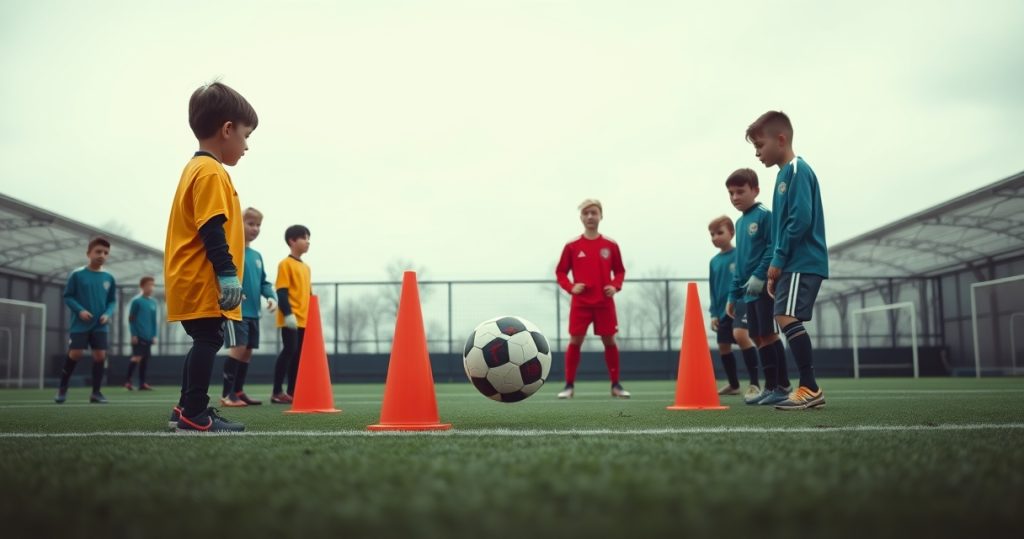
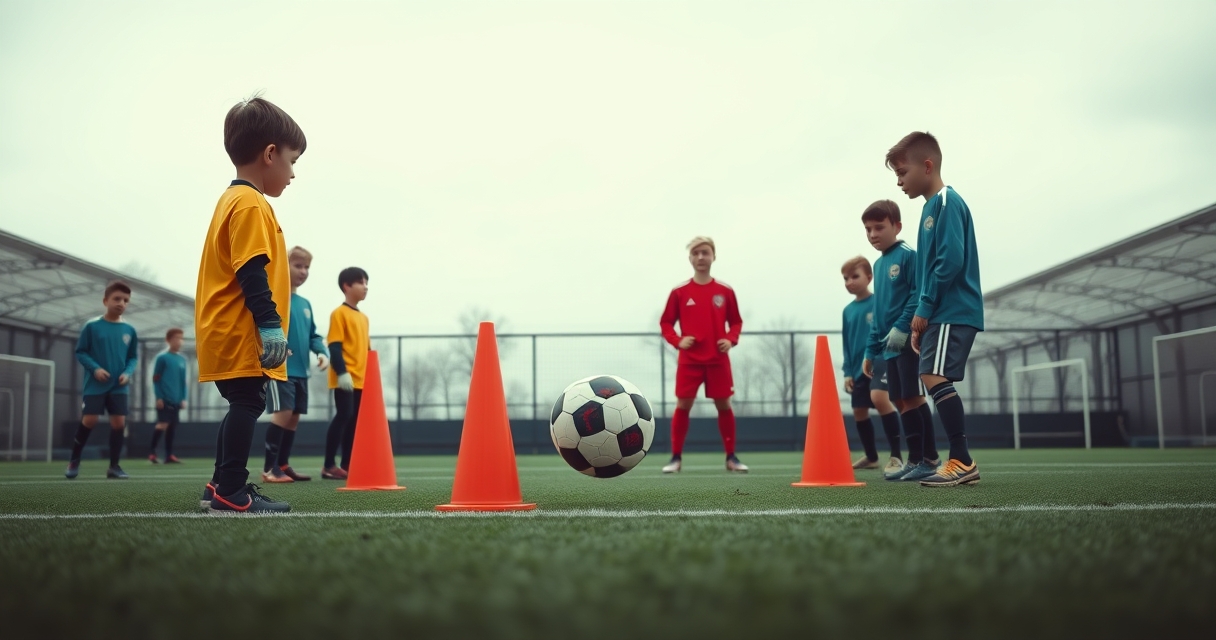
Every Saturday morning at the youth academy, ten-year-old keepers line up in front of two cones spaced five yards apart. The coach rolls a low-driven ball between the cones, and the keeper must shuffle sideways, drop into the set position, and smother the ball with both hands. It looks simple, but after twenty reps the keepers are breathing hard and their gloves are damp with sweat. That drill is not flashy; it is the foundation of basic goalkeeper training. Without mastering these fundamentals, young keepers will struggle when the game speeds up and the shots become unpredictable. The best youth programs spend 60 percent of each session on stance, footwork, catching, and distribution because these skills determine whether a keeper can make the next save or concede an avoidable goal.
Stance and Footwork Fundamentals
Start every session with the ready stance. Feet should be shoulder-width apart, knees slightly bent, weight on the balls of the feet, and hands relaxed in front of the body at waist height. This position allows the keeper to react quickly to any shot or pass. Many young keepers stand too upright, which slows their first step and makes it harder to dive low. A good rule is to keep the hips low enough that the fingertips can almost touch the ground without bending the back. From this stance, the keeper practices quick lateral shuffles, keeping the feet close to the ground to avoid crossing over. Coaches should mark a five-yard line and have the keeper shuffle back and forth ten times, focusing on staying balanced and not rising up.
Next, introduce the crossover step. When the ball is played wide, the keeper must cover ground quickly without losing balance. The first step is a crossover, where the outside foot steps over the inside foot, followed by a quick shuffle to adjust. This movement is essential for covering the near post on crosses and for recovering after a parry. A useful drill is to place two cones eight yards apart and have the keeper move between them using only crossover steps. After five reps, switch to shuffles for the same distance. This contrast helps the keeper feel the difference between explosive lateral movement and controlled side-to-side positioning.
Finally, add a reaction element. The coach stands five yards away and points left or right. The keeper must shuffle or crossover in the indicated direction and then return to the ready stance. This drill teaches the keeper to read cues and move decisively. Over time, the coach can add a ball to the mix, rolling it to either side after the point. The keeper must move quickly, set, and catch the ball. This progression builds muscle memory and confidence in the basic footwork patterns.
Catching Technique for Low and High Balls
Low balls are the most common save a youth keeper will face. The proper technique starts with the feet. The keeper should step forward with the foot closest to the ball, bending the knee to lower the body. The hands should form a W shape, with the thumbs almost touching and the fingers spread wide. The ball should be caught in front of the body, not to the side, to avoid spills. A common mistake is reaching too far forward, which can cause the ball to bounce off the hands. Instead, the keeper should meet the ball at the midpoint between the feet and the body, cushioning it into the chest if necessary.
For high balls, the keeper must jump with both feet, using the arms to generate upward momentum. The hands should form a basket, with the fingers pointing upward and the thumbs almost touching. The ball should be caught at the highest point of the jump, with the keeper landing on both feet to maintain balance. Many young keepers jump with only one foot, which makes it harder to control the landing and leaves them off-balance for the next play. A good drill is to have the keeper practice jumping and catching a ball thrown by the coach. The coach should vary the height and trajectory to simulate game conditions. After ten reps, the keeper should focus on landing softly and immediately returning to the ready stance.
Crosses add another layer of complexity. The keeper must judge the flight of the ball, communicate with defenders, and decide whether to catch or punch. A useful progression is to start with the coach throwing the ball from the sideline. The keeper must call “keeper” or “away,” move to the ball, and either catch it or punch it clear. The coach should vary the speed and height of the throw to keep the keeper guessing. Over time, this drill builds confidence in decision-making and physical execution. The key is to emphasize clean catches and safe punches, not just getting to the ball first.
Diving Progression for Youth Keepers
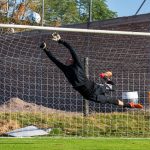
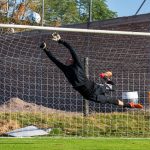
Diving is the most dramatic part of goalkeeping, but it should be introduced gradually. Start with the collapse dive, which is the safest and most controlled way to reach low shots. The keeper begins in the ready stance, then drops to one knee while extending the arm closest to the ball. The hand should be open, with the fingers spread wide, and the body should follow the arm to the ground. The other hand should brace the fall, and the keeper should roll onto the hip to avoid injury. A good drill is to have the keeper practice collapsing to both sides, focusing on keeping the head steady and the eyes on the ball. After ten reps, the coach can roll a ball to either side, forcing the keeper to dive and catch it.
yougotmojo: 9 Essential Goalkeeping Skills | Soccer Skills by MOJO
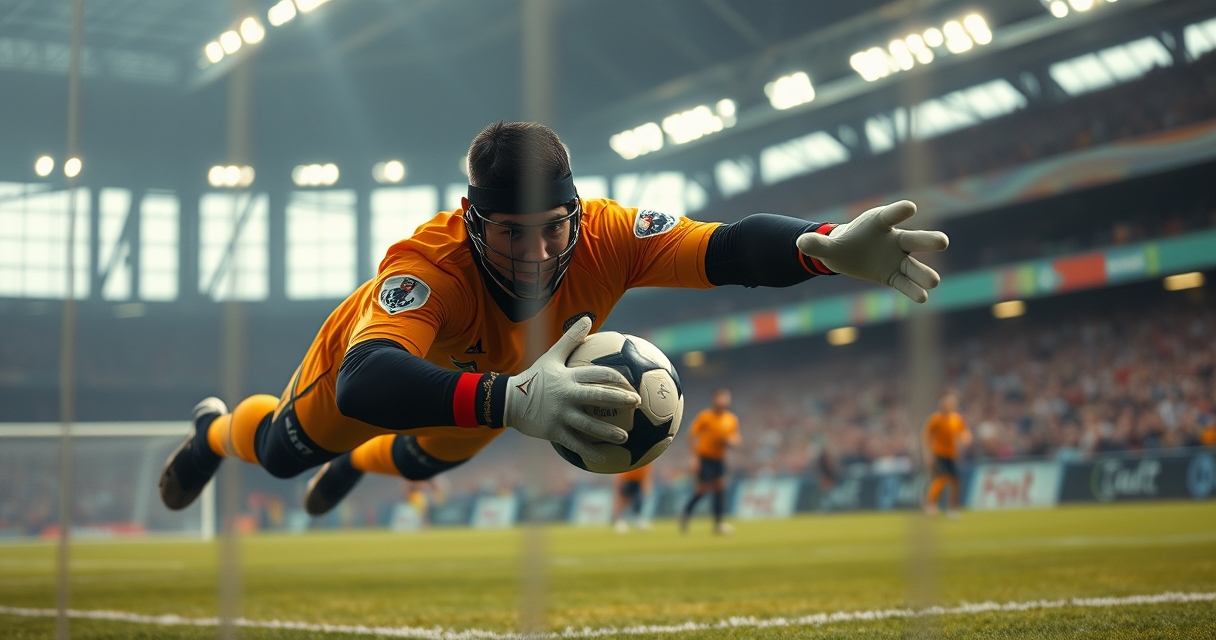
Next, introduce the low dive. The keeper starts in the ready stance, then pushes off the inside foot and dives sideways, extending the arm and leg to reach the ball. The body should be parallel to the ground, with the head leading the movement. The keeper should land on the hip and roll through the shoulder to absorb the impact. A useful progression is to place a cone five yards away and have the keeper dive to touch it, then return to the ready stance. After five reps, the coach can roll a ball to either side, forcing the keeper to dive and catch it. The key is to emphasize technique over distance; a controlled dive that stops the ball is better than a wild flail that misses it.
Finally, add the high dive. The keeper starts in the ready stance, then pushes off the inside foot and jumps sideways, extending the arm to reach the ball. The body should be angled upward, with the head leading the movement. The keeper should land on the hip and roll through the shoulder, just like in the low dive. A good drill is to have the keeper practice jumping and diving to catch a ball thrown by the coach. The coach should vary the height and trajectory to simulate game conditions. Over time, the keeper will develop the confidence and technique to make saves on shots that seem out of reach. The key is to build up gradually, starting with short dives and working up to full extension.
Distribution Drills for Quick Counterattacks
Modern goalkeepers must be comfortable with the ball at their feet. Start with the basic throw, which is the fastest way to start a counterattack. The keeper should hold the ball in both hands, step forward with the opposite foot, and release the ball with a smooth underhand motion. The throw should be aimed at the chest of the target player, with enough pace to reach them quickly but not so hard that it bounces. A good drill is to have the keeper practice throwing to a teammate standing ten yards away. The teammate should move side to side, forcing the keeper to adjust the throw. After ten reps, the keeper should focus on accuracy, hitting the teammate in the chest every time.
Next, introduce the roll. This is a slower but more accurate way to distribute the ball, especially over short distances. The keeper should hold the ball in both hands, step forward with the opposite foot, and roll the ball along the ground with a smooth motion. The roll should be aimed at the feet of the target player, with enough pace to reach them quickly but not so hard that it bounces. A useful progression is to have the keeper practice rolling to a teammate standing five yards away. The teammate should move side to side, forcing the keeper to adjust the roll. After ten reps, the keeper should focus on accuracy, hitting the teammate at the feet every time.
Finally, add the drop kick. This is the most powerful way to distribute the ball, but it requires good technique to be accurate. The keeper should hold the ball in both hands, drop it to the ground, and kick it as it bounces. The kick should be aimed at the chest of the target player, with enough pace to reach them quickly but not so hard that it bounces. A good drill is to have the keeper practice drop kicking to a teammate standing twenty yards away. The teammate should move side to side, forcing the keeper to adjust the kick. After ten reps, the keeper should focus on accuracy, hitting the teammate in the chest every time. The key is to emphasize technique over power; a well-placed kick is more useful than a wild punt that gives the ball away.
Positioning for Shots from Different Angles
Positioning is the invisible skill that separates good keepers from great ones. The basic rule is to split the angle between the ball and the goal. If the ball is at the edge of the six-yard box, the keeper should stand slightly off the near post, cutting off the shooter’s easiest option. If the ball is wide, the keeper should move toward the near post, reducing the angle for the shooter. A good drill is to place cones at different positions around the penalty area and have the keeper adjust their position based on where the ball is. The coach should call out a cone, and the keeper must move quickly to the correct spot. After ten reps, the coach can add a shooter, forcing the keeper to position themselves before the shot is taken.
For shots from central positions, the keeper should stand slightly off the center of the goal, giving themselves equal distance to both posts. If the shooter is directly in front of the goal, the keeper should move forward to narrow the angle, forcing the shooter to either chip the ball or take a more difficult shot. A useful progression is to have the keeper practice positioning against a shooter who moves side to side. The keeper must adjust their position based on the shooter’s movement, always keeping themselves between the ball and the goal. The key is to emphasize quick, small adjustments; the keeper should never be flat-footed when the shot is taken.
For shots from wide angles, the keeper must move toward the near post to reduce the angle. If the ball is on the left side of the field, the keeper should move toward the left post, cutting off the shooter’s easiest option. A good drill is to have the keeper practice positioning against a shooter who moves from the sideline toward the penalty spot. The keeper must adjust their position based on the shooter’s movement, always keeping themselves between the ball and the goal. Over time, the keeper will develop the instinct to position themselves correctly, even in chaotic game situations. The key is to emphasize anticipation; the keeper should be moving before the shot is taken, not reacting to it.
Reaction Drills for One-on-One Situations
One-on-one situations are the ultimate test of a keeper’s nerve and technique. The first rule is to stay big. The keeper should come off their line quickly, reducing the angle for the attacker. The body should be upright, with the hands in front of the body and the knees slightly bent. The keeper should not dive too early; instead, they should wait for the attacker to make the first move. A good drill is to have the keeper practice coming off their line against an attacker who dribbles toward the goal. The keeper must move forward quickly, staying on their feet and forcing the attacker to make a decision. After five reps, the coach can add a shot, forcing the keeper to react and make the save.
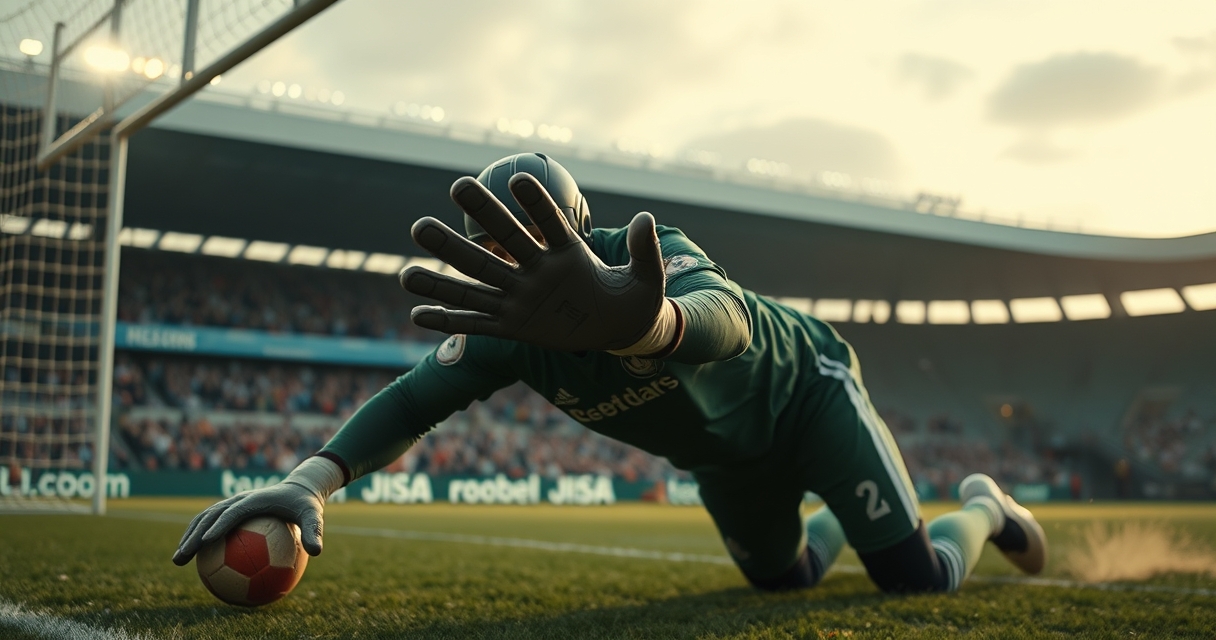
Next, introduce the block. If the attacker gets too close, the keeper must drop to one knee and extend the arms, covering as much of the goal as possible. The hands should be open, with the fingers spread wide, and the body should be low to the ground. The keeper should not try to catch the ball; instead, they should block it and then react to the rebound. A useful progression is to have the keeper practice blocking shots from close range. The coach should roll or throw the ball at the keeper, forcing them to drop and block it. After ten reps, the keeper should focus on getting their body behind the ball, not just their hands.
Finally, add the smother. If the attacker tries to chip the ball, the keeper must come off their line quickly and smother the ball at the attacker’s feet. The keeper should not dive; instead, they should stay on their feet and use their body to block the shot. A good drill is to have the keeper practice smothering against an attacker who tries to chip the ball. The keeper must move forward quickly, staying on their feet and forcing the attacker to make a decision. After five reps, the coach can add a shot, forcing the keeper to react and make the save. The key is to emphasize patience; the keeper should not commit too early, but they must be ready to react when the attacker makes their move.
Game-Like Scenarios for Match Realism
Drills are useless if they do not translate to the game. Start with a simple shooting drill. The coach sets up a line of shooters at the edge of the penalty area. The keeper must position themselves correctly, react to the shot, and make the save. The shooters should vary their shots, forcing the keeper to adjust their technique. After ten shots, the keeper should focus on their positioning, making sure they are always between the ball and the goal. The key is to emphasize realism; the shooters should not take their time, and the keeper must be ready to react quickly.
Next, add defenders. The coach sets up a small-sided game, with the keeper defending a full-sized goal. The keeper must communicate with their defenders, positioning themselves correctly and making saves when necessary. The coach should encourage the attackers to shoot from different positions, forcing the keeper to adjust their technique. After ten minutes, the keeper should focus on their distribution, making sure they can start a counterattack quickly after making a save. The key is to emphasize decision-making; the keeper must know when to come off their line, when to stay on their line, and when to distribute the ball.
Finally, add pressure. The coach sets up a game with a score, forcing the keeper to perform under pressure. The keeper must make saves, communicate with their defenders, and distribute the ball quickly. The coach should encourage the attackers to shoot from different positions, forcing the keeper to adjust their technique. After twenty minutes, the keeper should focus on their mental game, making sure they stay focused and confident even when the pressure is on. The key is to emphasize resilience; the keeper must be able to shake off a mistake and make the next save. This is the ultimate test of basic goalkeeper training, and it is where the best keepers separate themselves from the rest.

I’ve been playing soccer since I was a kid and love breaking down drills to help players improve. When I’m not on the pitch, I enjoy analyzing games and sharing practical tips with fellow enthusiasts.