The modern youth soccer landscape demands more than just technical repetition; it requires the ability to process information rapidly while executing under stress. Coaches frequently observe that players who dominate in unopposed drills often freeze when the game speeds up. Small-sided soccer games for decision making offer a structured solution, compressing the field to increase interaction frequency and forcing the brain to choose faster. By reducing space and increasing player density, these activities replicate the cognitive load of a real match, training the nervous system to prioritize the right option without hesitation. The following exploration details fifteen specific designs that target this pressure response, providing a practical toolkit for any training session.
Constraint-Based Scenarios to Trigger Urgent Choices
Implementing constraints within a small-sided framework forces players to abandon habitual thinking and seek alternative solutions. When a team is limited to two touches or must complete a pass within five seconds, the decision-making window shrinks dramatically. This compression mimics the urgency of a counter-attack or a tight defensive block, where hesitation leads to loss of possession. Coaches can rotate these constraints weekly, ensuring that the brain adapts to different types of pressure, whether it is time-based or touch-limited. The result is a player who feels more comfortable acting quickly, knowing that the environment has prepared them for that specific moment.
A classic example involves a 4v4+2 possession game where the two additional players act as neutral targets who must always be available. This setup creates constant pressure on the outnumbered team, who must decide quickly whether to switch the point of attack or retain the ball under duress. The neutral players act as safety valves, but their presence also demands that the primary players scan constantly to identify the best passing lane. Over time, this repetitive exposure reduces the “deer in headlights” effect, replacing panic with calculated risk assessment. The key is to enforce the rules strictly at first, then allow slight variations as the group adapts, always keeping the cognitive demand high.
Transition Zones that Mimic Game Realities
Transitions are the most chaotic moments in a soccer match, and small-sided soccer games for decision making must replicate this volatility. Designing drills that force an immediate switch from attack to defense, or vice versa, trains players to re-evaluate their options in a split second. A common method is to have the defending team trigger the transition by winning the ball, instantly making the former attackers the pressuring unit. This reversal requires the recovering team to instantly scan for cover, balance, and support, mirroring the ebb and flow of an actual contest.
In practice, this might look like a 5v5 game on a narrow channel where the moment the ball goes out of play or a tackle is made, the possession shifts to the other half of the channel. Players must quickly orient their bodies and identify new passing angles while under the gaze of opponents who are now sprinting to close space. This constant shifting teaches the brain to treat every ball contact as a potential turning point, reducing the likelihood of being caught out of position during a real match. The physical fatigue incurred also ensures that decision quality drops naturally, providing a realistic test of mental resilience.
Numerical Superiority and Inferiority Drills
Manipulating the player count is a direct way to alter the pressure experienced by the individuals on the pitch. A 3v1 keep-away game in a tight square creates immense pressure on the single defender, who must decide which passing lane to block while the three attackers look for the slightest gap. Conversely, a 1v3 situation forces the lone player to decide how to protect the ball and maybe escape the triangle, teaching resilience and quick thinking under siege. These extremes highlight how numbers dictate the complexity of the choice, and by oscillating between them, coaches can fine-tune a player’s risk-reward analysis.
An effective variation involves starting a possession game at 5v5 and, after a set number of passes, introducing a rule where two defenders enter the zone, creating a 5v7 scenario. The attacking side must then decide whether to maintain possession patiently or take a calculated risk to break the press. This shift from comfort to chaos forces a rapid reassessment of the tactical landscape. Players learn to value the ball more highly when outnumbered and to exploit space aggressively when they hold the advantage, developing a nuanced understanding of spatial geometry under stress.
Target Zones to Reward Strategic Thinking
Incorporating specific target areas on the field redirects a player’s decision-making focus toward strategic goals rather than random passing. By designating end zones or corner squares as the only valid places to score or complete a pass, players are compelled to look further ahead and scan the entire grid before acting. This setup transforms a simple keep-away into a chess match, where the immediate decision of “who do I pass to?” is secondary to “how do I get the ball into that specific zone?” The cognitive load increases as players must calculate angles, weight of pass, and timing simultaneously.
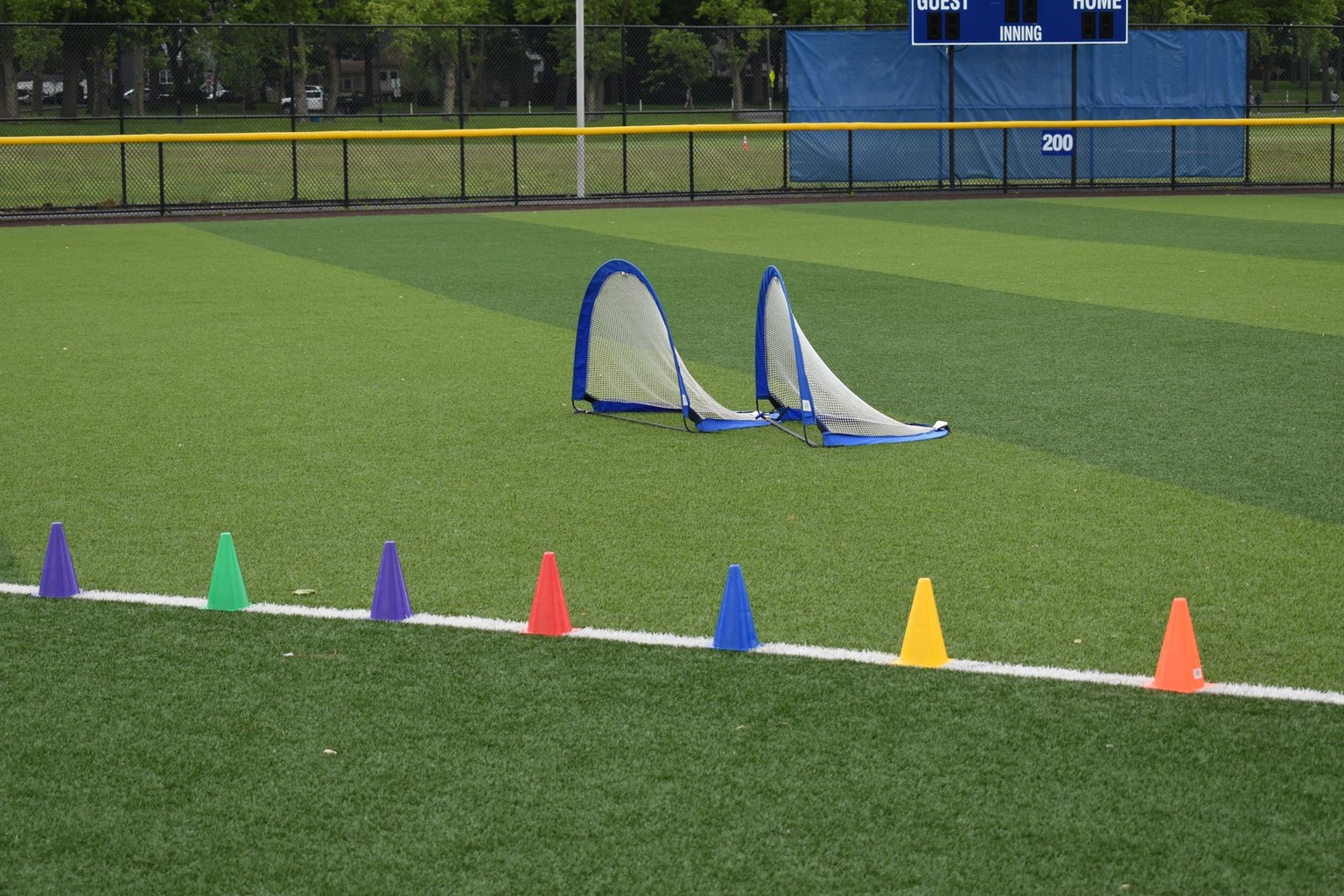
For instance, a 6v6 game might feature two small goals at each end, but players can only score by receiving the ball while standing inside a marked three-yard box. This requirement forces attackers to time their runs perfectly and defenders to coordinate their pressing triggers. The pressure comes from the knowledge that a misplaced pass or a mistimed run nullifies the effort, adding a layer of consequence to every touch. Over repeated sessions, this format builds a habit of forward planning, a critical component of high-level decision making that often separates good players from great ones.
Goalkeeper-Integrated Pressure Valves
Goalkeepers often serve as the first line of attack, and integrating them into small-sided soccer games for decision making can sharpen outfield players’ ability to distribute under duress. Drills that require the goalkeeper to distribute the ball within a limited time frame or to specific zones force the outfielders to anticipate the launch and position themselves accordingly. This dynamic creates a feedback loop where the keeper’s decision influences the attackers’ movement, and vice versa. It simulates the real-match scenario where a goalkeeper’s kick or throw initiates the team’s offensive structure.
A practical exercise might involve a 4v4+GK format where the team in possession must complete a set number of passes before they are allowed to score, but the goalkeeper can only release the ball after a verbal cue from a coach or a visual signal. This constraint forces the outfield players to create space quickly, knowing that the ball will soon be in play. The pressure is twofold: the attackers must finish quickly, and the defenders must press intelligently to prevent an easy outlet. This interplay teaches players to value the transition phase and to make decisions that consider the entire pitch, not just the immediate vicinity of the ball.
Shadow Play with Live Opposition
Shadow play traditionally involves players moving without a ball, but adding a live opposition transforms it into a decision-making drill. In this setup, one team performs a planned movement pattern while the other team reacts and attempts to intercept or disrupt. The executing team must decide in real-time whether to stick to the plan or adjust based on the opponent’s positioning. This blend of rehearsed structure and reactive pressure challenges the brain to balance predictability with adaptability, a vital skill for midfielders and attackers who must often deviate from the script.
For example, the “attacking” team might practice a third-man run, but a defending team is placed in a passive position that quickly becomes active. As the movement develops, the defenders’ decisions to step or hold force the attackers to re-evaluate their passing options instantaneously. The cognitive effort required to maintain the intent of the play while responding to unexpected resistance builds a higher level of tactical intelligence. It ensures that players do not become robotic executors of tactics but remain intelligent problem solvers on the field.
Endurance-Linked Cognition Drills
Physical fatigue is a primary catalyst for poor decision making, as tired muscles slow reaction times and muddy mental clarity. Small-sided soccer games for decision making that incorporate endurance elements, such as mandatory jogging between zones or reduced rest periods, test a player’s ability to think clearly while the body is screaming for rest. These drills are particularly effective late in training sessions or early in the season when fitness levels vary. The goal is to simulate the late-game scenario where a player must still execute a precise pass or defensive positioning despite being physically spent.
An example could be a 7v7 game where every time a player loses possession, they must perform a five-second burpee before re-entering the play, or simply jog back to a designated line. This rule ensures that the game pace fluctuates and that players are constantly making decisions while their heart rates are elevated. The result is a desensitization to the stress of fatigue, teaching the brain to prioritize the most critical information even when resources are low. This type of training is invaluable for developing players who can maintain composure during the final minutes of a tight match.
Small-Sided Soccer Games for Decision Making as a Seasonal Tool
Integrating these drills into a broader training plan requires an understanding of periodization and player development stages. Young players benefit from a higher frequency of these games early on, as their cognitive plasticity is high and they are eager to experiment with new solutions. As players mature, the complexity of the rules and the speed of the game can be increased to match their growing tactical awareness. Coaches should view small-sided soccer games for decision making not as a standalone fix, but as a recurring element that evolves alongside technical and physical training modules.
The versatility of these games allows them to be tailored to specific positional needs as well. Defenders might focus on drills that emphasize intercepting passes and clearing under pressure, while attackers might prioritize games that reward quick combinations and forward runs. By rotating the focus each week, the entire squad develops a well-rounded ability to handle pressure from various angles. The ultimate aim is to create a team culture where making the right choice under stress becomes second nature, reducing unforced errors and increasing the team’s overall competitive edge.

I’ve been playing soccer since I was a kid and love breaking down drills to help players improve. When I’m not on the pitch, I enjoy analyzing games and sharing practical tips with fellow enthusiasts.