

Young players who master agility become the most unpredictable forces on the field, able to change direction faster than defenders can react and outmaneuver opponents with effortless precision. For coaches working with youth soccer teams, integrating simple agility exercises is one of the quickest ways to sharpen footwork, improve first-touch control, and reduce injury risk. These drills don’t require expensive equipment or hours of practice; they focus on fundamental movement patterns that translate directly into game situations. The best part is that when done correctly, they make training sessions more engaging for kids while building the physical foundation needed for advanced techniques later on.
The Foundation: Why Agility Matters in Youth Soccer
Agility isn’t just about speed, it’s about how quickly a player can adjust their body position in response to a stimulus, whether that’s a defender closing in, a teammate passing the ball, or a goalkeeper’s throw. Research from the National Strength and Conditioning Association emphasizes that agility training improves coordination, balance, and reaction time, all of which are critical for young players still developing their technical skills. For a 10-year-old dribbling through a cone drill, agility means being able to pivot on one foot, accelerate through a tight space, and stop abruptly without losing control. Without these basics, even the most technically gifted players struggle when faced with unpredictable game scenarios. The good news is that simple agility exercises can be woven into warm-ups or cool-downs without taking up extra practice time, making them ideal for busy youth coaches.
One common misconception is that agility exercises are only for advanced players, but expert consensus from the American College of Sports Medicine clarifies that foundational agility drills should start as early as age 6 or 7. The key is to keep movements simple and fun, using games like “red light, green light” or obstacle courses with cones to teach directional changes. These early exposures build neural pathways that later support more complex movements, such as quick cuts around defenders or explosive sprints into space. For coaches, this means prioritizing drills that mimic game-like movements, like lateral shuffles or backward runs, over static exercises that don’t translate to on-field performance.
Prerequisites: Setting Up for Success
Before introducing any simple agility exercises, it’s essential to ensure players have the physical and mental readiness to perform them safely. Warm-up routines should always include dynamic stretches like leg swings and high knees to increase blood flow and joint mobility. According to guidelines from the FIFA Medical Assessment and Research Centre, static stretching before agility drills can actually reduce performance, so coaches should focus on movements that mimic soccer actions, like toe taps or butt kicks, rather than holding stretches for extended periods. Additionally, players should wear proper cleats with good traction to prevent slips during quick directional changes. A quick pre-drill check to ensure everyone is hydrated and dressed appropriately can prevent unnecessary injuries and keep the session focused.
The environment also plays a role in how effective simple agility exercises are. Outdoor fields with natural grass or artificial turf provide better grip than hard surfaces, while indoor gyms with rubber flooring can work well for drills like ladder sequences. Coaches should avoid setting up exercises in areas with uneven ground or obstacles that could trip players. For drills requiring cones or markers, ensure they’re placed at least 3-5 meters apart for younger players to allow for safe acceleration and deceleration. If space is limited, coaches can use small cones or even players’ own bodies to create reaction-based drills, like mirroring movements with a partner. The goal is to create a controlled but engaging environment where players can focus on technique without fear of injury.
Step 1: Mastering the Basics with Cone Drills
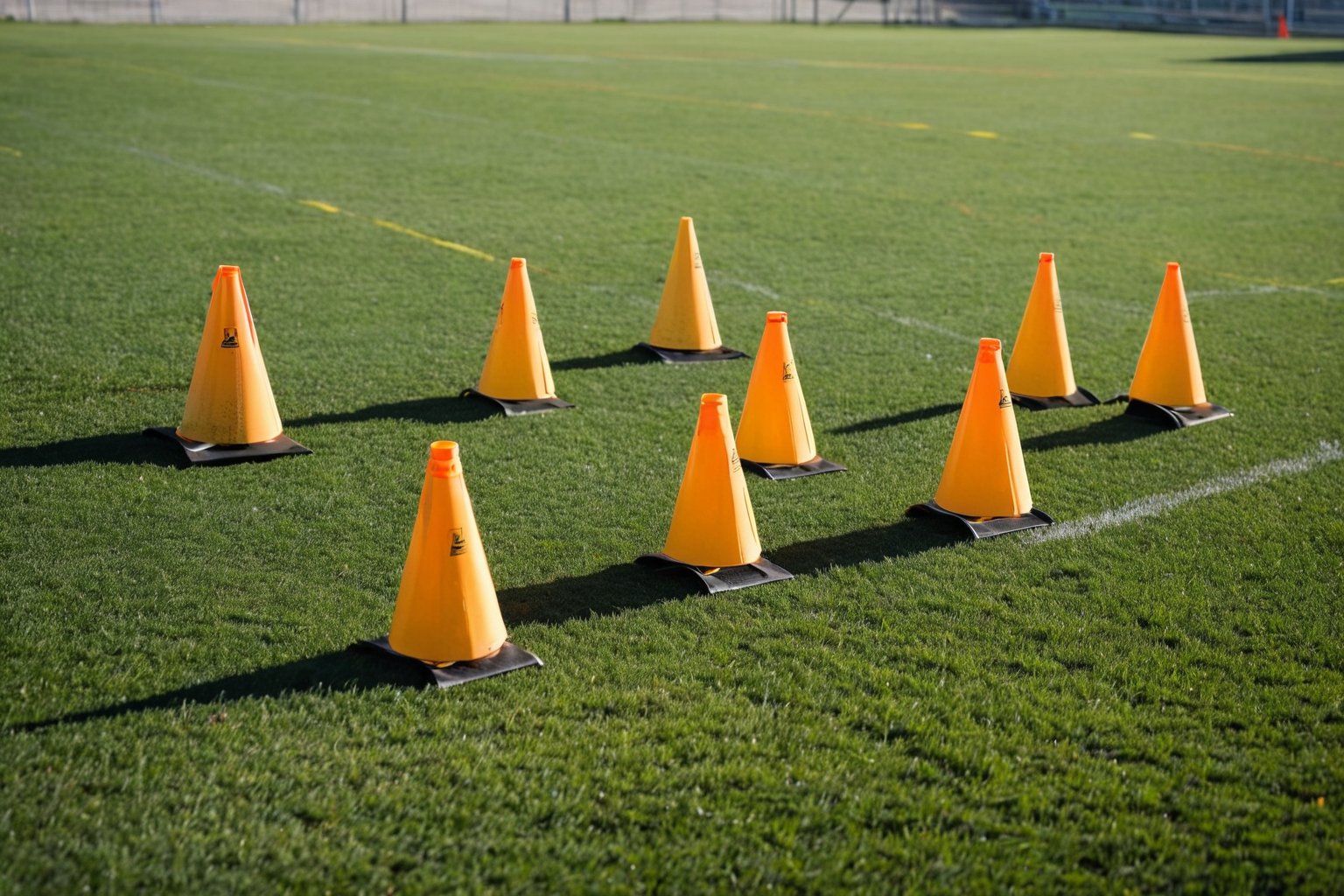
The most straightforward and effective simple agility exercises for youth soccer start with cone drills, which teach players how to change direction efficiently. A classic setup involves placing four cones in a square formation, about 5 meters apart, and having players shuffle sideways, forward, and backward through each corner. The key is to emphasize small, quick steps rather than long strides, as this builds control and reduces the risk of overstriding, where players lose balance when turning. Coaches should start with slow repetitions to reinforce proper form before increasing speed. For younger players, adding a ball to the mix, like dribbling through the cones, can make the drill more soccer-specific while reinforcing ball control alongside agility. This foundational drill is often recommended by soccer-specific conditioning experts like those at the UEFA Football Development Centre, which highlights its role in developing lateral quickness, a skill critical for defenders and midfielders alike.

A variation that adds complexity is the “zigzag drill,” where cones are placed in a straight line with slight offsets, forcing players to weave in and out. This mimics the kind of tight spaces players face in 1v1 duels or when breaking down defensive lines. To make it more challenging, coaches can introduce a reaction element, like clapping their hands or shouting “now!”, to simulate an unexpected pass or defender closing in. For players who struggle with coordination, starting with a slower pace and gradually increasing tempo helps them internalize the movement pattern. The simplicity of these drills makes them perfect for short training sessions, and their adaptability means they can be scaled for players of all ages and skill levels. Over time, players who consistently practice cone drills will notice their ability to turn and accelerate more smoothly, directly improving their effectiveness in games.
Step 2: Incorporating Reaction-Based Agility
While static cone drills build foundational agility, reaction-based exercises push players to think and move faster, mirroring the demands of a real match. One of the most effective simple agility exercises for youth soccer is the “reaction cone drill,” where a coach stands behind a player with a ball and calls out directions like “left,” “right,” or “forward” at random intervals. The player must react by dribbling or running in the indicated direction as quickly as possible. This drill not only improves agility but also enhances decision-making under pressure, a skill that separates good players from great ones. Research from the Journal of Sports Sciences supports the use of unpredictable cues in training, as they better prepare athletes for the chaotic nature of competition. For younger players, coaches can start with verbal cues and later introduce visual signals, like waving a flag or pointing, to add another layer of complexity.
Another reaction-based drill is the “mirror drill,” where two players face each other and must mirror each other’s movements, like shuffling left when the partner shuffles right. This exercise improves spatial awareness and coordination while keeping players engaged through teamwork. To make it more soccer-specific, coaches can introduce a ball, requiring players to pass or dribble in response to their partner’s movements. The simplicity of this drill makes it easy to integrate into warm-ups, and its collaborative nature ensures that even less confident players feel involved. For teams practicing in larger groups, coaches can set up multiple mirror pairs around the field, allowing for parallel drills that maximize training time. The key is to keep the focus on quick, controlled reactions rather than speed, as this builds the foundational agility that translates to better performance in games.
Step 3: Adding Game-Like Context with Small-Sided Games
While isolated agility exercises are valuable, their effectiveness skyrockets when combined with game-like scenarios. Small-sided games, like 3v3 or 4v4, force players to use their agility in real-time, making decisions under pressure while moving toward the ball. According to the United States Soccer Federation, small-sided games are one of the most efficient ways to develop technical and tactical skills in youth players, as they require constant movement and quick adjustments. To emphasize agility, coaches can add rules that encourage players to change direction frequently, such as requiring a player to dribble around a cone before scoring or passing. This turns the game into a natural extension of the agility drills practiced earlier in the session. For example, a “cone chase” game where players must weave around three stationary cones before attacking the goal teaches both agility and spatial awareness in a fun, competitive format.
The beauty of small-sided games is that they adapt easily to different age groups and skill levels. For younger players, coaches can simplify the rules, like reducing the number of cones or increasing the size of the playing area, to ensure everyone can participate. Conversely, older or more advanced players can be challenged with tighter spaces or additional constraints, such as requiring a specific type of pass (e.g., a first-time through-ball) before scoring. To further link agility to soccer skills, coaches can incorporate technical elements like quick turns or step-overs into the games. For instance, a player must perform a 180-degree turn around a cone before joining the attack, reinforcing the connection between agility and ball control. This approach ensures that players aren’t just moving faster, they’re moving smarter, which is what makes them more valuable in games.
Common Mistakes to Avoid
Even the simplest agility exercises can become ineffective, or even harmful, if coaches or players make common mistakes. One of the most frequent errors is prioritizing speed over control, leading players to overstride or take large, uncontrolled steps during directional changes. This not only reduces agility but also increases the risk of injury, particularly for younger players whose muscles and tendons are still developing. To correct this, coaches should consistently reinforce the idea that small, quick steps are more effective than long strides, especially in tight spaces. Another mistake is neglecting proper footwork, such as landing flat-footed or using the wrong foot for turns. This can throw off balance and slow down reactions. Coaches should model the correct technique, like landing on the balls of the feet and using the inside or outside of the foot for changes of direction, and provide immediate feedback when players deviate from the form.
Another pitfall is treating agility exercises as standalone drills rather than integrating them into broader training sessions. For example, a player who practices cone drills in isolation may not transfer those skills to game situations where they need to combine agility with passing or shooting. To bridge this gap, coaches should follow agility drills with small-sided games or scrimmages that require players to use their newfound quickness. Additionally, some coaches make the error of assuming that more repetitions equal better results, leading to repetitive drills that lose players’ interest. Instead, variety is key, mixing up drills, introducing new challenges, and keeping the environment dynamic helps maintain engagement and prevents plateaus in development. Finally, it’s crucial to avoid pushing players too hard too soon. Agility training should be progressive, with intensity and complexity increasing gradually to allow players to build strength and coordination safely. If players show signs of fatigue or frustration, coaches should scale back the intensity or switch to a different drill.
Advanced Progression: Taking Simple Exercises to the Next Level
Once players have mastered the basics of simple agility exercises, coaches can introduce more advanced variations that challenge their coordination and reaction time. One effective progression is the “ladder drill,” where players move through a ladder laid out on the ground, performing quick footwork patterns like in-and-outs or lateral shuffles. This drill improves foot speed and agility while also enhancing balance and body control. According to the American Council on Exercise, ladder drills are particularly effective for developing quick, precise movements that translate to better ball control in soccer. To make it more soccer-specific, coaches can have players dribble a ball through the ladder or perform a skill, like a step-over, after completing each pattern. For teams with limited space, a mini ladder (about 3 meters long) can be used, or players can work in pairs, taking turns moving through the ladder while the other watches and corrects form.
Another advanced progression is the “defender reaction drill,” where a player with the ball must react to a defender’s movements. The defender starts in a stationary position and then sprints toward the ball carrier at random intervals, forcing the ball handler to make quick decisions about when to accelerate, decelerate, or change direction. This drill not only improves agility but also enhances tactical awareness, as players learn to read their opponent’s intentions. To increase difficulty, coaches can introduce a third player, a “support player”, who must time their run toward the ball carrier to create space. This creates a more game-like scenario where agility, passing, and teamwork are all tested. For younger players, the defender can start closer to the ball carrier to reduce the risk of collisions, while older players can benefit from a defender who starts farther away, requiring more advanced decision-making. The key is to ensure that players understand the purpose of the drill, reacting to a defender’s movements, to make the most of the exercise.

I’ve been playing soccer since I was a kid and love breaking down drills to help players improve. When I’m not on the pitch, I enjoy analyzing games and sharing practical tips with fellow enthusiasts.