Benefits of Soccer Drills in Limited Spaces
Practicing soccer drills in limited spaces offers numerous advantages, making it an essential part of the fundamentals of soccer training routine. Limited space training challenges players to refine their skills under conditions that mimic real-game pressure, where space is often restricted. This type of small area practice helps enhance a player’s technical abilities, agility, and ball control, all critical components for success on the field.
One of the primary benefits of focused small area practice is the improvement in ball control. When the space to maneuver is confined, players must learn to manage the ball more precisely to maintain possession. This intense ball handling develops better footwork, sharper touch, and quicker decision-making, which are transferable to larger field situations. Indoor soccer drills, commonly conducted in restricted environments, are perfect for honing these control skills.
Another significant advantage of soccer drills in limited spaces is the enhancement of agility. Limited space training requires players to make fast, tight turns, quick stops, and reactive movements, which improve overall coordination and balance. Agility gained through these drills boosts a player’s ability to navigate crowded spaces during matches, evade opponents, and create scoring opportunities.
Moreover, practicing in confined areas increases a player’s spatial awareness and decision-making speed. With less room to operate, players must constantly scan their surroundings and anticipate opponents’ moves, fostering better strategic thinking and quicker reactions. This heightened awareness is crucial for outplaying competitors in tight spaces during a game.
Indoor soccer drills, in particular, offer a controlled environment for limited space training, allowing players to maintain consistent practice regardless of weather conditions. The repetitive nature of these drills helps build muscle memory and confidence with the ball, translating into more effective performances in outdoor matches.
In conclusion, incorporating soccer drills that focus on limited space training is beneficial for players aiming to sharpen their skills. Small area practice not only improves ball control and agility but also boosts mental sharpness and spatial awareness. These combined benefits make limited space drills a valuable element of any soccer training program.
Improved Ball Control and Agility
Limited space soccer drills are essential for players aiming to enhance their ball control drills and agility exercises. When practicing within constrained areas, players are forced to make quicker decisions and refine their touch on the ball. This pressure creates an environment where precise ball handling becomes a necessity, improving overall control. Tight space soccer drills also emphasize the importance of maintaining close ball proximity, which is a critical skill during real game scenarios where defenders are constantly pressuring.
Furthermore, limited space training promotes rapid directional changes. Players learn to maneuver skillfully around opponents by making sharp cuts, quick pivots, and sudden stops, all executed with seamless ball control. These agility exercises not only develop footwork but also train the mind to anticipate movements and react swiftly. As a result, players become more confident and effective in congested areas on the field, transforming tight spaces into opportunities rather than obstacles.
Incorporating ball control drills and agility exercises together enhances the player’s coordination and balance, ultimately contributing to superior in-game performance. For those who play in smaller fields or face heavy defensive pressure, practicing limited space soccer drills is particularly beneficial. It sharpens the skills needed to navigate through tight situations while maintaining full command of the ball, making it an invaluable part of any soccer training regimen.
Maximizing Training in Small Areas
Training in limited spaces demands strategic planning to ensure that every session remains productive and focused. Small area training harnesses the power of space optimization to deliver efficient soccer practice without compromising quality. By carefully organizing drills and utilizing the confines of a smaller field, players can develop sharper technical skills and quicker decision-making abilities.
One effective strategy is to design drills that emphasize close ball control and tight passing sequences. This forces players to operate in restricted zones, improving their precision and spatial awareness. Using cones, markers, or even portable goals can help define clear boundaries within the small space, keeping the practice structured and purposeful.
Another approach involves rotating players through high-intensity, short-duration drills to maximize engagement and maintain movement within the compact area. This not only keeps energy levels high but also simulates real-game pressure situations where players must think and act quickly in tight spaces. Coaches can also leverage small-sided games to enhance competitiveness and teamwork, all while optimizing the limited training ground.
Ultimately, the key to successful small area training lies in creatively adapting exercises to suit the environment. By focusing on space optimization, coaches ensure that every moment on the field contributes to developing essential skills, resulting in efficient soccer practice that prepares players for the dynamic demands of the sport.
Top Soccer Drills for Limited Space
- Wall Pass Drill: This drill involves passing the ball against a wall and controlling its rebound, perfect for limited space drills. It sharpens passing accuracy and first-touch control. To do this, stand a few feet from a wall, pass the ball firmly, and trap it on its return using different parts of your foot. This exercise requires minimal space and is excellent for indoor soccer training.
- Close-Control Dribbling: In a confined area like a small backyard, practice tight dribbling using cones or markers. Focus on keeping the ball close to your feet while weaving through the obstacles. This drill boosts ball control and agility, essential for small area soccer exercises where space is restricted.
- Quick Feet Ladder Drill: Use an agility ladder or imaginary markings to perform quick footwork drills. Rapidly step in and out of each square, emphasizing speed and precision. This drill helps improve foot speed and coordination without needing much room.
- Two-Touch Passing: Working with a partner in a narrow space, practice two-touch passing to simulate game-like pressure. Limit yourself to just two touches before passing the ball back. This drill develops quick decision-making and sharpens passing skills in tight areas.
- Target Shooting Drill: Set up small goals or targets within your limited space and practice shooting accuracy. Focus on controlled shots and hitting specific areas of the target. This is a great way to enhance your finishing skills even when space and time are constrained.
- Shadow Dribbling: Without a ball, mimic dribbling movements focusing on foot placement and body posture. This drill is ideal for indoor soccer training sessions where you want to improve technical skills without needing a big area.
These best soccer drills are tailored to make the most of any limited space, whether indoors or in small backyard settings. Incorporating these exercises into your routine will enhance your ball control, agility, passing, and shooting skills effectively without the need for a full-sized field.
Cone Dribbling and Control Drill
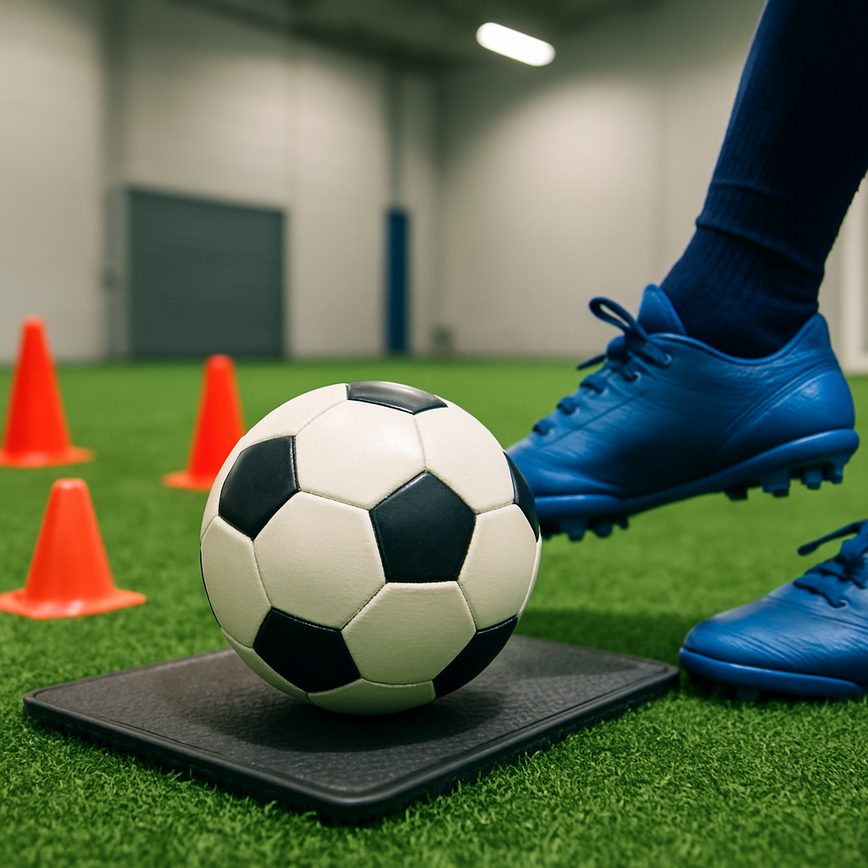
To set up an effective cone dribbling and control drill, place a series of cones in a straight line or zigzag pattern with approximately one to two feet of space between each cone. This compact setup is ideal for practicing ball control in limited space, challenging your ability to maneuver the soccer ball precisely.
Start by slowly dribbling the ball through the cones using the inside and outside of your foot. Focus on keeping the ball close to you at all times to improve your tight space control. As you become more comfortable, increase your speed while maintaining control. This cone drill encourages quick footwork and sharp changes in direction, which are essential skills in congested game situations.
Keep your head up as much as possible during the drill to simulate in-game awareness, and use small, controlled touches to navigate through the cones without knocking them over. Incorporating various dribbling exercises like this into your training routine hones your ability to handle the ball confidently even in the tightest spaces on the field.
For added difficulty, try using only your weaker foot or vary the pattern of the cones. This drill not only builds dribbling skills but also enhances your overall ball control, making it an excellent choice for players looking to improve their performance in small, crowded areas during matches.
Wall Pass and Trap Drill
Practicing wall pass and trap drills is an effective way to enhance your passing precision and improve reaction time, especially when working within limited space. This exercise requires using a wall to bounce the ball back to you, offering continuous practice that sharpens control and accuracy.
Here is a step-by-step guide to mastering wall pass and trap exercises in small areas:
- Find a solid, flat wall with enough space to stand about 3 to 5 feet away.
- Start by passing the ball against the wall using the inside of your foot for controlled touch.
- After the ball rebounds, trap it using the sole or the inside of your foot to stop the ball cleanly.
- Repeat the pass and trap sequence steadily, focusing on consistency and precision.
- Try alternating feet to develop stronger control on both your dominant and weaker foot.
- Increase the pace gradually as you feel more comfortable to improve your reaction time.
- Incorporate different passing heights and speeds to simulate various game situations.
- Practice regularly to build muscle memory and better spatial awareness during play.
Incorporating wall pass and trap drills as part of your passing drills routine is an excellent way to sharpen your skills in confined spaces. This drill not only hones precision but also heightens your reaction time, preparing you for fast-paced scenarios on the field.
Quick Feet and Agility Ladder Drill
Quick feet exercises using an agility ladder are an excellent way to improve speed, coordination, and footwork drills indoors, especially when space is limited. To begin, lay your agility ladder flat on the floor or use tape to create a ladder-like pattern if space constraints exist. Stand at one end with your feet shoulder-width apart.
Start by stepping quickly into the first square with both feet, one after the other, maintaining a light bounce on your toes. The goal is to move as rapidly as possible without sacrificing form. Keep your knees slightly bent and your arms active to help maintain balance and rhythm. As you move through each square, focus on landing softly and pushing off the ground with each step to increase speed.
Once comfortable with single foot entries, introduce variations such as the “in-and-out” drill, where each square is entered with both feet simultaneously before stepping outside the sides and moving to the next square. Other footwork drills can involve lateral movements or sprinting through the ladder to enhance agility further. Consistent practice enhances neuromuscular coordination crucial for quick feet and overall agility.
Incorporating these agility ladder quick feet exercises regularly into your routine helps build faster foot speed, better balance, and sharper reaction times essential for soccer performance. This drill can be done indoors, making it perfect for those with limited training space.
Tips for Optimizing Limited Space Soccer Training
Maximizing the effectiveness of soccer practice in a limited area requires strategic planning and smart use of space. Whether you’re a coach or a player, following these training tips can help you boost soccer practice efficiency and make every square foot count during your sessions.
Firstly, focus on drills that emphasize close ball control and quick decision-making. Small area coaching inherently limits the room for long passes and sprawling runs, so concentrate on exercises that enhance dribbling, short passing, and rapid changes in direction. These skills translate well into game scenarios where space is tight and quick thinking is essential.
Secondly, organize your training area to minimize downtime and maximize activity. Use portable cones or markers to create multiple small grids within the available space. This allows different groups or pairs of players to work simultaneously on various drills without interfering with each other. Efficient use of space ensures that training volume remains high and players stay actively engaged.
Thirdly, integrate small-sided games into your sessions. Games like 3v3 or 4v4 simulate real match conditions on a smaller scale, enhancing tactical awareness, positioning, and teamwork within confined spaces. These games not only improve technical skills but also increase the intensity and competitiveness of training, driving better results in less area.
Another key training tip is to carefully plan the sequence of drills to maintain a smooth flow throughout the session. Transition quickly from one activity to another to keep players focused and prevent idle time. This flow contributes to space optimization by making sure that every moment on the pitch is used productively.
Lastly, emphasize the importance of communication and spatial awareness. When space is limited, players must constantly communicate and anticipate the movement of teammates and opponents. Incorporating communication drills and exercises that encourage spatial awareness will deepen players’ understanding of how to operate effectively within confined areas.
In summary, successful small area coaching requires an emphasis on technical skills suited to tight spaces, well-structured sessions, and smart use of all available space. By incorporating these training tips, coaches and players can significantly enhance the quality and efficiency of their soccer practice, making the most of their limited environment.
Using Multifunctional Equipment
When training in limited space environments, selecting the right training equipment can make a significant difference. Multifunctional equipment designed for space saving tools offers versatility and maximizes the effectiveness of every session. For example, agility ladders can be used not only for footwork drills but also for speed and coordination exercises, making them invaluable for tight training areas.
Another excellent option is using cones that serve multiple purposes in multifunctional drills. These cones can be arranged for dribbling courses, short sprints, or obstacle navigation, all within a small footprint. Adjustable rebounders and portable goalposts also enhance training variety without requiring a large field, giving players the opportunity to practice passing, shooting, and ball control efficiently.
Moreover, combining equipment like resistance bands with mini hurdles allows coaches to implement strength and agility drills simultaneously, optimizing time and space. Investing in such space saving tools enhances training sessions by catering to different skills, especially when outdoor or spacious indoor venues are not available. Multifunctional training kits are ideal for coaches looking to boost player development with limited resources.
Scheduling and Routine Consistency
Maintaining a consistent training schedule is key to making the most of limited space in your soccer drills. Without routine consistency, players may struggle to build muscle memory, refine skills, and maintain motivation. Regularly planned practices transform small areas into effective training zones by ensuring each session has clear goals and structure.
When space is constrained, intelligently designing a training schedule becomes even more crucial. Prioritize routines that maximize the use of the available area while targeting different skills across sessions. This approach prevents monotony and promotes steady improvement, even if the physical space cannot be expanded. Careful practice planning helps balance skill drills, fitness, and tactical awareness within the same limited environment.
Consistency also allows players to track progress over time. By sticking to a well-organized schedule, coaches and players have a reliable framework to measure improvement and adjust routines as needed. This systematic approach enhances efficiency, making sure that the time spent training in tight spaces translates into real skill development. Ultimately, a disciplined training schedule paired with routine consistency empowers players to overcome spatial limitations and continue growing as athletes.

I’ve been playing soccer since I was a kid and love breaking down drills to help players improve. When I’m not on the pitch, I enjoy analyzing games and sharing practical tips with fellow enthusiasts.