Coaches searching for effective mirror drills for soccer players often discover that these exercises bridge the gap between technical repetition and genuine game intelligence. The concept is straightforward: two athletes face each other and one initiates a movement while the other replicates it in real time, forcing both participants to process visual cues instantly. This dynamic sharpens the peripheral scanning habits that separate reactive runners from proactive playmakers. When implemented correctly, the drill teaches athletes to keep their heads up while manipulating the ball or adjusting their body shape to receive a pass. I have seen youth sides transform their off-the-ball timing within six weeks simply by adding two ten-minute sessions per week to their standard curriculum.
Understanding the Cognitive Foundation of Mirror Training
The neurological demand of mirror work goes far beyond simple mimicry because it forces the brain to couple perception with action under time pressure. Research in motor learning suggests that anticipation skills improve when athletes practice reading kinematic cues such as hip rotation or shoulder drops before an opponent actually moves. By rehearsing this coupling repeatedly, players build a mental database of movement patterns that they can access automatically during matches. The drill essentially compresses the decision-making cycle so that recognition and response happen almost simultaneously. Over time this reduces the cognitive load during competitive situations, allowing athletes to allocate attention to tactical options rather than basic coordination.
A well-structured session begins with static positioning before introducing locomotion, ensuring that the visual-motor link is solid at walking pace first. Coaches should emphasize that the follower’s eyes stay fixed on the leader’s midsection rather than the feet, because the torso reveals intention earlier than the extremities. This gaze strategy mirrors what elite forwards do when timing runs behind a defensive line. I typically allocate the first three minutes to shadow movements without a ball, then layer in passing combinations once the rhythm feels natural. The progression respects the brain’s need for stable patterns before adding complexity.
Setting Up the Grid and Equipment for Maximum Repetitions
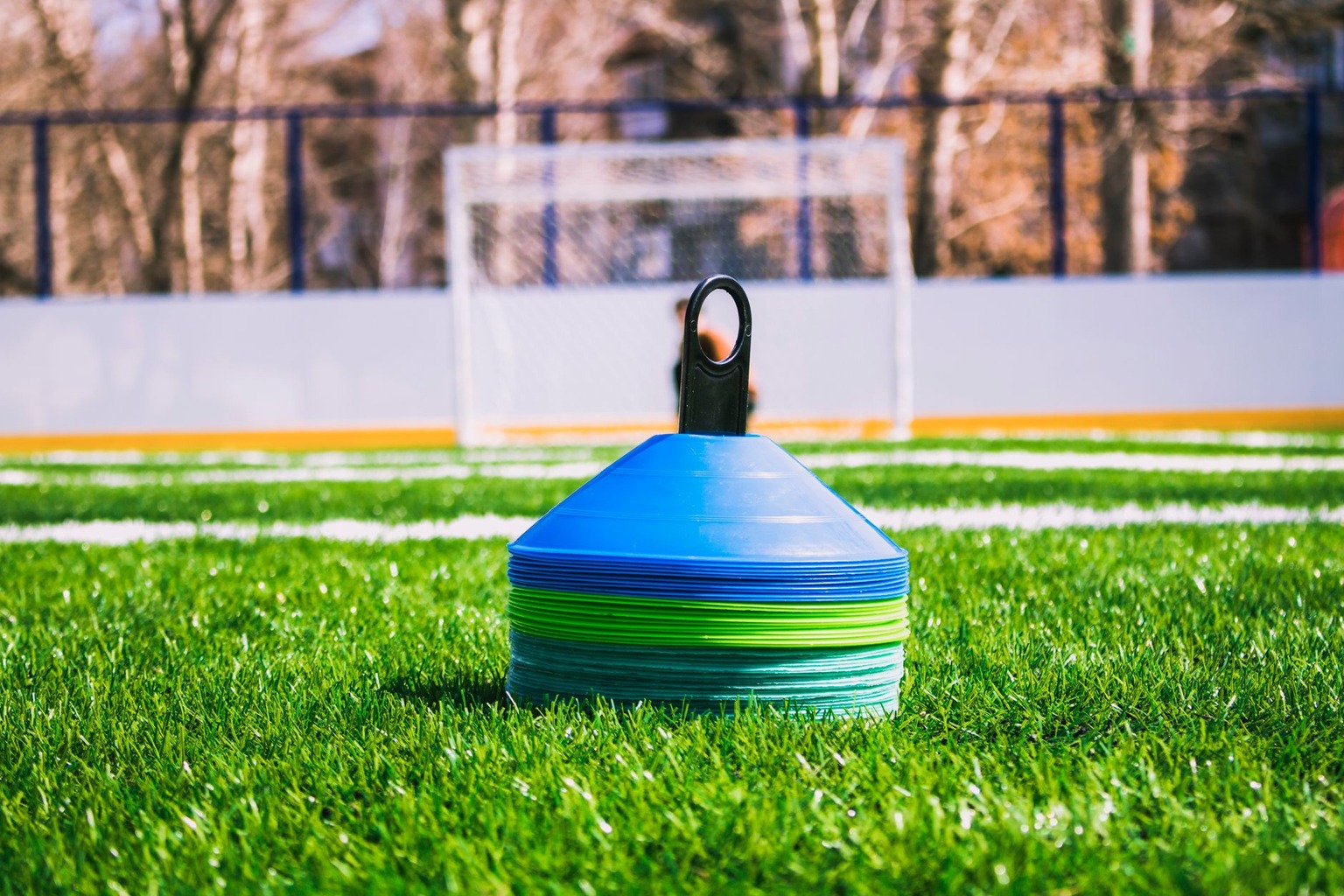
Space management determines whether the exercise flows or stagnates, so I mark a ten-by-ten-yard box for every pair using flat cones that do not trip players during sudden stops. Each athlete needs a ball at their feet for the advanced variations, but the initial phase requires only bibs to distinguish roles quickly. A stopwatch and a whistle help the coach enforce strict work-to-rest ratios, typically thirty seconds on and thirty seconds off, which mimics the intermittent intensity of a real match. Keeping the grid tight forces quicker feet and sharper changes of direction, both of which transfer directly to congested midfield areas.
Portable goals or target zones placed on opposite ends of the box add a directional purpose that pure shadowing lacks. When the leader dribbles toward a target, the follower must decide whether to press, intercept, or delay, turning the drill into a tactical conversation rather than a dance routine. I rotate pairs every four minutes to expose athletes to different movement signatures, preventing them from memorizing a single partner’s tendencies. This variety accelerates the perceptual adaptation that makes mirror training so valuable for defensive awareness.
Progressing from Static Mirroring to Dynamic Interceptions
The first progression removes the ball entirely and focuses on lateral shuffles, drop steps, and sudden accelerations triggered by the leader’s shoulder feints. Athletes learn to maintain a low center of gravity while mirroring, which builds the eccentric strength needed for rapid deceleration on game day. I cue the leader to vary tempo unpredictably, two slow steps followed by an explosive burst, so the follower cannot fall into a rhythm. This unpredictability trains the nervous system to stay alert rather than anticipate a fixed pattern.
On the Prepare For Performance channel, they explain how to master the mirror drill for better reactive movement, and you can watch it right here.
Once the movement quality looks clean, I introduce a single ball carried by the leader while the follower shadows without one, simulating a defender tracking a dribbler. The follower practices closing passing lanes by positioning their body between the ball and the target zone, a skill that directly supports zonal marking concepts. The next layer gives both players a ball, forcing the leader to protect possession while executing the same feints and the follower to mirror while maintaining their own control. This dual-task condition skyrockets cognitive load and reveals which athletes can truly multitask under pressure.
Integrating Passing Sequences to Simulate Off-Ball Runs
Mirror drills for soccer players reach their highest transfer value when passing combinations replace pure dribbling, because off-the-ball movement is fundamentally about timing runs to receive. I set up a three-player triangle where the leader initiates a give-and-go with a neutral passer stationed outside the grid, then mirrors the passer’s supporting angle before spinning into space. The follower must track the run, communicate with the passer, and decide whether to step tight or drop off. This sequence rehearses the exact visual triggers, eye contact, body opening, first touch direction, that midfielders scan for during build-up play.
To deepen the tactical layer, I assign specific scenarios such as breaking a high press or exploiting the half-space between lines. The leader rehearses a designated movement pattern, check away, check to, spin behind, while the follower practices the corresponding defensive response. We run each scenario for two minutes, then swap roles and discuss what cues gave the run away. This reflective pause cements learning far better than continuous repetition without feedback. Players start recognizing these patterns in video review sessions within a month.
Common Technical Errors and How to Correct Them
The most frequent mistake I see is the follower watching the ball instead of the opponent’s hips, which leads to late reactions on sudden direction changes. A simple correction is to have the leader wear a brightly colored vest on the torso, drawing the eyes upward automatically. Another error is standing too upright during lateral shifts, which slows the first step; I fix this by placing a low hurdle behind each athlete so they must stay bent to avoid contact. These external constraints teach posture better than verbal reminders alone.
Over-striding during backward mirroring creates balance vulnerabilities that attackers exploit with quick turns. I address this by shortening the grid to eight yards and insisting on choppy, frequent steps rather than long reaches. Some athletes also freeze their upper body while their legs move, eliminating the deceptive shoulder drops that make mirroring effective. Holding a light medicine ball at chest height forces the trunk to stay engaged and mobile. Each correction targets a specific biomechanical flaw that would otherwise become ingrained through repetition.
Conditioning Considerations and Load Management
Because mirror work involves frequent accelerations, decelerations, and lateral cuts, it places high demand on the groin, hamstrings, and ankle stabilizers. I schedule these sessions early in the week when freshness is highest, avoiding the day before a match to prevent residual fatigue from affecting sprint performance. Heart-rate data from my U-16 group shows averages around 85 percent of max during the active intervals, confirming the drill’s conditioning value. However, volume must be monitored, more than twenty total minutes of high-intensity mirroring can degrade movement quality and increase injury risk.
Recovery between bouts should be active rather than static; light jogging around the grid keeps the muscle pump going and clears lactate faster than standing still. I also pair mirror blocks with technical passing circuits at lower intensity to maintain session flow without overloading the same movement patterns. For younger age groups, I reduce interval length to twenty seconds and extend rest to forty seconds, respecting their developing anaerobic capacity. Smart load management ensures the cognitive gains are not erased by physical breakdown.
Measuring Progress and Translating to Match Performance
Tracking improvement requires objective markers beyond the coach’s eye, so I use a simple scoring rubric: successful interceptions, times beaten on the turn, and quality of first touch under pressure. Each athlete receives a weekly scorecard that highlights trends over a six-week block. Video analysis adds another layer, tagging moments where a defender mirrored an attacker’s run and forced a backward pass provides concrete evidence of transfer. Parents and players appreciate the transparency, and it guides individual development plans.
The ultimate test arrives on game day when a center midfielder recognizes a striker’s check-run early and steps into the passing lane, or a fullback shadows a winger’s inside movement without diving in. Those moments validate the hours spent in ten-yard boxes. I remind my squad that mirror training is not a magic bullet but a deliberate practice tool that sharpens the perception-action loop. When combined with small-sided games and tactical film study, it builds the complete awareness package that modern soccer demands.

I’ve been playing soccer since I was a kid and love breaking down drills to help players improve. When I’m not on the pitch, I enjoy analyzing games and sharing practical tips with fellow enthusiasts.